
E0 vs E1 vs E2 Plywood: Which Formaldehyde Standard Does Your Export Market Require?

When importing plywood for indoor use, formaldehyde emission class is one of the first compliance questions buyers face. Get it wrong and your shipment may fail customs, fail a green building audit, or simply be rejected by your end customer.
This guide explains what E0, E1, and E2 mean, how Japan and the United States define their own standards, and which grade your export market actually requires.
Why Formaldehyde Emissions Matter
Plywood is bonded with resin adhesives, most commonly urea-formaldehyde (UF) or phenol-formaldehyde (PF). These resins release formaldehyde gas over time after installation. In enclosed indoor environments, accumulated emissions can cause respiratory irritation and, at sustained high levels, pose longer-term health risks.
Emission standards exist to set a safe upper limit on how much formaldehyde a panel can release. The classification system most widely used internationally is E0, E1, and E2.
E0, E1, E2: What the Numbers Mean
The E classification system originates from European standards and measures formaldehyde concentration released by a panel under controlled laboratory conditions.
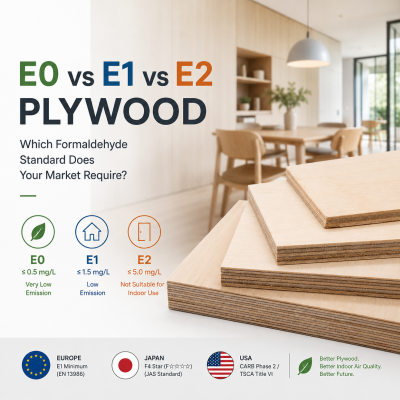
E1 is the baseline standard for indoor use in most markets. It permits formaldehyde emissions up to 1.5 mg/L under the perforator test method, or 0.1 ppm under chamber testing. Since 2006, E1 has been the mandatory minimum for wood-based panels sold in the European Union. For general commercial interiors, residential furniture, and cabinetry in non-sensitive environments, E1 is widely accepted.
E0 is a stricter grade, limiting emissions to 0.5 mg/L or below. It is increasingly specified for applications where indoor air quality is a priority: schools, hospitals, children’s furniture, and premium residential interiors. E0 is not a mandatory threshold in most markets, but it is growing in importance as green building certifications and sustainability-conscious buyers push for lower emission materials.
E2 was originally used in applications where indoor air quality was a lower priority, such as exterior cladding, structural panels in ventilated spaces, or industrial uses outside enclosed environments. It allows emissions up to 5.0 mg/L, a level that is no longer considered acceptable for occupied interior spaces under modern health and safety expectations.
Most regulated markets, including the European Union, have now phased out E2 for indoor applications. Importers and exporters supplying finished goods or components for interior use should avoid E2 entirely. Beyond the health concern, specifying E2 creates real commercial risk: retailers, contractors, and green building certifiers in developed markets will reject panels that do not meet E1 as a minimum, and end users are increasingly aware of emission labeling.
How Japan and the United States Define Their Standards
The E classification is widely understood, but Japan and the United States use their own regulatory systems. Buyers supplying these markets need to know what is actually required.
Japan: F Star (JAS Standard)
Japan regulates formaldehyde emissions through the Japanese Agricultural Standard (JAS) using the F Star rating system, ranging from F1 to F4 Star. F4 Star (F☆☆☆☆) is the most stringent, requiring emissions below 0.005 mg/m2/h under JIS A 1460 test conditions. This is the standard required for unrestricted use in interior applications in Japan, including bedrooms and schools.
F4 Star uses a different testing methodology from the European E system and is generally regarded as one of the most stringent formaldehyde emission classifications for interior wood products in the world. Plywood destined for the Japanese market should carry JAS F4 Star certification, supported by testing from an accredited laboratory.
United States: CARB Phase 2 and TSCA Title VI
The United States regulates formaldehyde through the California Air Resources Board (CARB) Phase 2 standard, which was adopted federally under TSCA Title VI in 2019. Since March 2019, all hardwood plywood sold or imported into the United States must meet CARB Phase 2 limits, regardless of where it was manufactured.
For hardwood plywood with a veneer core, CARB Phase 2 requires emissions below 0.005 ppm. Compliance must be verified by a third-party certifier and documented on product labeling. Shipments without valid CARB certification cannot legally enter the US market.
Which Standard Applies to Your Market?
| Market | Required Standard | Notes |
|---|---|---|
| European Union | E1 minimum | E2 not permitted for indoor use since 2006 |
| Germany, Austria, Scandinavia | E1 or stricter | Some national regulations exceed EU baseline |
| Japan | F4 Star (JAS) | Different test methodology; required for unrestricted interior use |
| United States | CARB Phase 2 / TSCA Title VI | Mandatory for all hardwood plywood since 2019 |
| Australia / New Zealand | E1 equivalent | Referenced under AS/NZS 2098 |
| General export / unspecified | E1 as safe baseline | E0 increasingly preferred for premium applications |
Typical Requirements by Product Type
Beyond destination market, the intended application also determines which grade is appropriate.
| Product Type | Common Requirement |
|---|---|
| Film faced plywood | E1 |
| Flooring plywood | E1 or E0 |
| Furniture plywood | E0 |
| Export to Japan | F4 Star (JAS) |
| Export to USA | CARB Phase 2 |
When in doubt, specifying E0 provides a safe margin that satisfies most market requirements and positions the product for premium or sustainability-driven applications.
What to Ask Your Supplier
Not all suppliers who claim E0 or E1 compliance can back it up with documentation. Before finalizing a purchase, request the following:
- Test report from an accredited third-party laboratory
- Certificate number and issuing body
- Validity period of the certification
- Whether the certification covers the specific panel type and thickness you are ordering
A reliable manufacturer will provide this documentation without hesitation. If a supplier cannot produce verified test reports, the emission claim should not be trusted.
What Standards Can AMC Vietnam Supply?
AMC Vietnam produces plywood certified to the emission standards required by major export markets, including:
- E1 plywood for general export and EU market requirements
- E0 plywood for premium, healthcare, and sustainability-driven specifications
- CARB Phase 2 compliant plywood for the United States market
- FSC-certified plywood for buyers who require verified sustainable sourcing
- Film faced plywood for construction and formwork applications
- Flooring plywood for export markets requiring E1 or E0 compliance
All panels come with full third-party test documentation. Buyers can request certificates and test reports before placing an order.
Summary
Formaldehyde emission standards are not interchangeable across markets. E1 is the accepted baseline for most European and general export applications. E0 is appropriate for sensitive environments and sustainability-driven specifications. E2 should be avoided for any interior end use in regulated markets.
Japan uses the F4 Star classification under JAS, which operates under a different testing methodology and is among the most stringent standards for interior wood products globally. The United States mandates CARB Phase 2 compliance for all imported hardwood plywood under TSCA Title VI.
Knowing which standard applies to your market and product type before you source is the simplest way to avoid compliance failures, delays, and added cost at the point of entry.
Contact AMC Vietnam to request product specifications, emission certificates, and test documentation for your target market.