
Why Marine Plywood Costs More And When It’s Worth It
When buyers compare plywood quotes and notice marine-grade panels priced significantly higher than standard options, the first question is always the same: Is it actually worth it?
The honest answer is: it depends entirely on where the plywood will be used. In the right environment, marine plywood pays for itself many times over. In the wrong one, you are simply overpaying.
This article breaks down what makes marine plywood different, what it genuinely costs over time, and how to decide whether your project actually needs it.
What Makes Marine Plywood Different
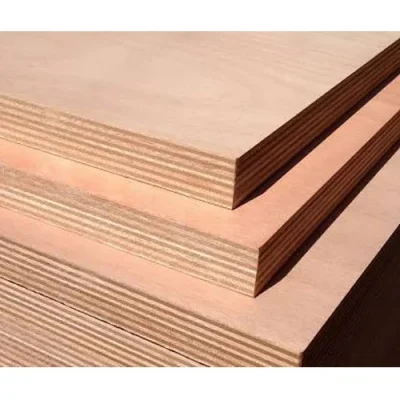
Marine plywood is not just regular plywood with a premium label. The difference starts at the core and runs through every layer of manufacturing.
Veneer quality. Marine-grade panels are built from high-quality hardwood veneers, species like eucalyptus, keruing, or meranti, selected for density and structural consistency. Face veneers must be free from open knots, splits, and voids. Core veneers are held to the same strict standard: under the BS 1088 specification (the most widely recognized international benchmark for marine plywood), voids in the core cannot exceed 1.5 mm in any direction.
Compare this to standard commercial plywood, where core voids up to 3 mm or larger are acceptable. Those gaps seem minor until moisture finds them, and in wet environments, it always does.
Adhesive system. Marine plywood uses WBP, Weather and Boil Proof phenolic resin, an adhesive that must survive a 72-hour boiling water test without any delamination between plies. It is worth noting that WBP adhesive is also used in some exterior-grade plywood. What makes marine grade distinct is not the glue alone, but the combination of WBP adhesive with void-free, high-quality veneers throughout. Both elements work together: the adhesive resists delamination under sustained moisture, while the veneer quality eliminates the internal gaps that water would otherwise exploit.
Manufacturing consistency. Marine plywood production involves tighter pressing controls, more rigorous quality inspection at each stage, and consistent veneer thickness across every ply. The result is a panel with predictable strength, minimal internal stress, and dimensional stability that holds up under loading and humidity changes.
The Real Cost of Marine Plywood
Buyers focused on price-per-sheet often reach the wrong conclusion. The more useful metric is cost-per-year-of-service.
In applications where the plywood is embedded in a structure, a boat hull, a dock subframe, a container floor, replacement is rarely just the cost of a new sheet. It involves disassembly, disposal, and reinstallation. When a standard panel fails prematurely in a demanding environment, the labor and downtime costs alone often dwarf the original price difference between standard and marine grade.
Specifying the wrong panel for a wet environment does not save money. It defers a larger cost.
Where Marine Plywood Is Worth the Investment
Marine plywood is the right specification for any project where moisture exposure is sustained, repeated, or unavoidable.
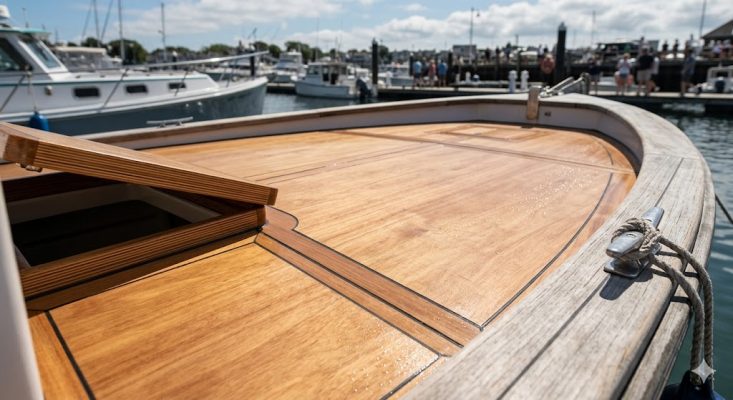
Boat building and marine structures. Hulls, transoms, bulkheads, and deck framing all face direct and prolonged water contact. This is the environment marine plywood was engineered for. No other panel type provides the same combination of structural strength, void-free core, and WBP adhesive performance.
Docks, piers, and waterfront construction. Freshwater and saltwater environments create constant humidity and periodic immersion. Even well-coated panels will experience moisture at joints, fastener points, and cut edges. A WBP-bonded core holds integrity where standard plywood would delaminate within one or two seasons.
Container flooring. Shipping containers move between climates, from humid tropics to cold dry ports, and carry heavy, shifting loads. Marine plywood is widely specified for container flooring because it resists the dimensional changes that cause standard panels to buckle or crack under these conditions.
Coastal construction and outdoor structures. In high-humidity coastal environments, even panels that are not directly exposed to water absorb significant atmospheric moisture. For outdoor kitchens, covered docks, and beachside structures, marine grade provides durability that exterior plywood, while water-resistant, cannot reliably match over the long term.
When Marine Plywood Is Not Necessary
Marine plywood is not the right choice for every application, and specifying it where it is not needed adds cost without adding value.
For interior furniture, cabinetry in dry environments, wall sheathing, and most residential construction applications, standard or exterior-grade plywood is entirely appropriate. The WBP adhesive and void-free core of marine plywood provide no measurable benefit in conditions where moisture is not a factor.
One practical guideline: if the panel will stay dry for the majority of its service life, and any moisture exposure is brief and incidental rather than sustained, marine grade is not required.
What to Look for When Buying Marine Plywood
Not all panels sold as “marine plywood” meet the same standard. The term is used broadly, and product quality varies significantly depending on the source and specification behind the label.
For projects where performance is critical, look for panels manufactured to BS 1088, the most rigorous internationally recognized specification for marine-grade plywood. BS 1088 certification requires void-free cores, WBP adhesive that passes a full boil test, and face veneers free from open defects.
Additional certifications to consider include FSC chain-of-custody for buyers who require verified sustainable sourcing, and CARB Phase 2 compliance for exports to the United States market.
When evaluating suppliers, ask for documentation rather than labels. A reputable manufacturer will provide test results and certification records, not just product descriptions.
The Right Specification for the Right Application
Marine plywood costs more because it is built to perform in conditions that would destroy standard panels. The higher upfront price reflects tighter veneer selection, a more demanding adhesive system, and stricter manufacturing controls.
For boat builders, dock contractors, container manufacturers, and anyone working in sustained wet environments, the investment is justified, not just in material performance, but in total project economics over the service life of the structure.
For dry interior applications, standard or exterior-grade plywood remains the cost-effective and appropriate choice.
The decision is straightforward once the application is clear: specify for the environment, not for the sticker price.
AMC Vietnam produces marine-grade plywood and a full range of hardwood plywood products for export. Our panels are manufactured to international quality standards and are available in both standard and custom specifications for demanding applications.